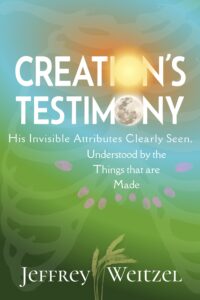
I want to speak about a term that has popped up numerous times in reference to Creation’s Testimony — “Natural Theology.” It is a term that, on the surface seems like a tidy category that a book about finding God in the natural world would easily fit into. While I never felt that my writing was following any sort of traditional framework that would already be represented by an existing field of study, and though I wasn’t looking for a box to put it in for marketing or other purposes, when I first saw the term, I felt intrigued. Was I simply one of many before me to have come up with similar ideas? So I looked into what it was.
Natural Theology as a field of study is defined as, “a program of inquiry into the existence and attributes of God without referring or appealing to any divine revelation” (from the Internet Encyclopedia of Philosophy). No divine revelation. That means no Bible. No prayer. No voice of God. Only Nature. This is the idea we call science today.
I must admit that it is an intriguing thought to see how far one could go trying to prove the existence of God without the use of God. My book even sort of goes that direction in saying that the generations before Moses were pretty much in that boat. They didn’t have scriptures yet, and it is part of my thesis that they used the natural world to figure a lot of things out about the nature of God. But what they didn’t have to do is figure out if God actually existed in the first place. That much was the biggest “duh!” to them you can imagine. It probably never occurred to them that God didn’t exist. All of the early peoples and nations understood there was a God (or many gods…) The idea that the creation came about by pure chance over millions of years without any god is actually quite modern and would have sounded ludicrous to even the pagan nations. So the patriarchs did not need to suffer from not “appealing to any divine revelation.” They certainly had prayer and the voice of God. Some of them even had God standing next to them in physical form, too! They used the natural world to discover the nature of its Creator, but they did so with the guidance of that very Creator!
The concept of Natural Theology goes back to Ancient Greece where the philosophers used the idea as a sort of exercise. The thought was that, if God exists, He should be able to be deduced simply by the natural world. This exercise has been handed down through the generations of philosophers into the modern era. It has at times had more popularity than others, but what hasn’t happened over the last 2500 years is for there to have been a definitive answer to the question of whether God exists through this methodology.
This doesn’t amaze me because if we look at the premise of the methodology, it is that God must first be completely removed from the picture before we look for Him! By not being allowed to appeal to any divine revelation, the task has become futile. It is in effect making the statement that God does not exist, and even if He did, you cannot look for Him or at Him if you do find Him because that would be outside of the rules. You can look for Him anywhere you want, except for where He actually is. Happy hunting!
One thing we can see in the Bible is that people do not find God by simply looking for Him, or through scientific methods. They find God by appealing to Him through obedience and faith, and allowing God to reveal Himself to them in His time. He is a God of revelation, not of science. So a methodology that by its own rules disallows divine revelation is either disingenuous or at least fatally flawed.
I actually think that even with such an illogical set of rules, it would be hard to deduce that there is no God by looking at nature in a purely scientific way — at least if the science is honest. But maybe it is all about your starting supposition. Very few ever go into such a field without any preconceived notions. There have been many scientists who, after lifetimes of study, have been convinced that God exists. And there have been many who have spent whole careers staring the evidence in the face and simply said that it wasn’t God. But those who concluded that God must exist allowed for the revelation. They didn’t follow the rules. Had they followed the rules of Natural Theology, they would have been obliged to look the other direction.
So is Creation’s Testimony a book of Natural Theology? No. At least not by its own definition. However it does seem that the term can often be used in modern parlance in a much looser context, such as I might have thought of it when I first heard it. As a formal philosophical or theological discipline, I completely reject it. Yet because most casual readers are not formally studied academic types, it is quite possible that, for better or worse, it will be found on shelves (physical or electronic) beside both books that do conform to such things and books that simply recognize that the creation and the Creator are inseparable.